Here is a sample of architecture that caught my eye as I walked around Old Mazatlán.

[Source: oceanblueworld.com]


a weblog of whereabouts & interests, since 2010
Here is a sample of architecture that caught my eye as I walked around Old Mazatlán.


We attended Fiesta del Agave 2026 at the El Cid Golf & Country Club here in Mazatlán today.
There were tables with bottles of mezcal and tequila* for tasting (and to buy, of course).
We sat in on chef Héctor Saracho’s food prep demonstration. He prepared a ceviche from Sierra Spanish mackerel, served up on a made-from-scratch toasted tortilla shell. (Chef Saracho has impressive credentials. He travels to Cabo San Lucas and elsewhere to cook for the likes of Jennifer Aniston, George Clooney and Howard Stern.)
Then we had a little lunch and tasted some locally brewed beer (excellent, and the stout was the best).
The mariachi band arrived just then and we listened to three or four songs before calling it a day.
The sunset is from a new acquaintance’s lookout over the beach in Mazatlán’s Golden Zone.
*Mezcal and tequila are almost the same, but not quite.
Here is Google AI Overview explaining:
Tequila is a type of mezcal, but not all mezcal is tequila. The primary differences are in agave type, region, and production: Tequila uses only Blue Weber agave, mostly in Jalisco, typically steamed. Mezcal uses various agave types (mainly Espadín) roasted in earthen pits, giving it a distinctive smoky flavor.
There was a marine layer out on the ocean this morning as we made our way to Cerro del Vigía (‘Lookout Hill’).
We took the short cable car trip up to the observatory: the touristic park named Observatorio 1873, after the year of its construction.
By the observatory there is a small agaviario (a dedicated agave garden) and steps down to a bird sanctuary called El Nido. A few steps further down the hill there is an enclosure with iguanas and tortoises.
The last stop is the new whale museum called Museo Nacional de la Ballena (National Whale Museum) that opened in August 2025.
(Thanks to Bryan for the picture of the toucan and of the green parrot).
Here is a closer look at the Cathedral Basilica of the Immaculate Conception of Mazatlán (La Catedral Basílica de la Inmaculada Concepción en Mazatlán).
It is a Roman Catholic Church that was built in the Baroque-Revival style from 1856 to 1899. Approximately 78% of Mexico’s population identifies as Catholic, according to the 2020 Mexican government census.
Based on available history for the city’s central public spaces, the notable iron gazebo located in the plaza directly in front of the Cathedral (Plaza República) was built around 1870.
It was another sunny and cloudless day here in Mazatlán (76°F /24°C ).
This morning, we went for a walk up the main lookout hill here on the shoreline (Cerro del Vigía).
This afternoon, we ran out to the local Sam’s Club (warehouse grocery store) for grocery shopping. We went there by bus and came back with a little Uber car with its trunk and back seat full of groceries.


It just happened to be Día de la Bandera— National Flag Day— today here in Mexico.
While catching the sunset at the beach in Old Mazatlán, we spotted the giant Mexican flag on the flagpole way down along the promenade (the far left in the second picture)—a rare treat since it’s only up a few days each year.
We reached it in the nick of time, just as the flag was being lowered and taken away.
P.S. Built in the early 1920s (often cited as 1919–1920) by Californian Louis Bradbury, Hotel Belmar is Mazatlán’s original oceanfront hotel, representing the city’s golden age. Located on the Olas Altas boardwalk, it was a 1940s/50s hot spot for Hollywood stars like John Wayne and Lucille Ball, known for its elegant, historic, and slightly bohemian atmosphere.
I arrived in Mazatlán, Mexico, today (to visit my two amigos that had been here since January).
I was not sure right up until Sunday night that my trip would happen, because violence broke out in Puerto Vallarta and Jalisco state over the weekend after drug lord El Mencho was killed in an operation.
Here is a brief update from the New York Times:
The authorities in Mexico appeared to have restored order in multiple cities on Monday after a wave of violence set off by the killing of a major cartel leader left highways blocked, buildings burned and at least 62 people dead.
Mexico’s most powerful criminal organization, the Jalisco New Generation Cartel, unleashed the chaos after its leader, Nemesio Oseguera Cervantes or El Mencho, the nation’s most wanted cartel boss, died in a military raid on Sunday in western Jalisco State.
Pictures below:
There was a system-wide glitch with the new automated bag drop machines at Seattle airport when I checked in early this morning, but it was soon resolved;
The Boeing 737 MAX 9 (twin-jet) at the gate that took us to Los Angeles’s LAX airport;
Alaska Air and United Airlines airplanes at Terminal 6 at LAX;
Stepping on board the Boeing 737-900 (twin-jet) that took us to Mazatlán;
Welcome sign with picture of Old Mazatllan, on the wall at arrival in the airport;
Sunset over the Pacific Ocean tonight, seen from the beach by Centro Histórico, or Old Mazatlán.
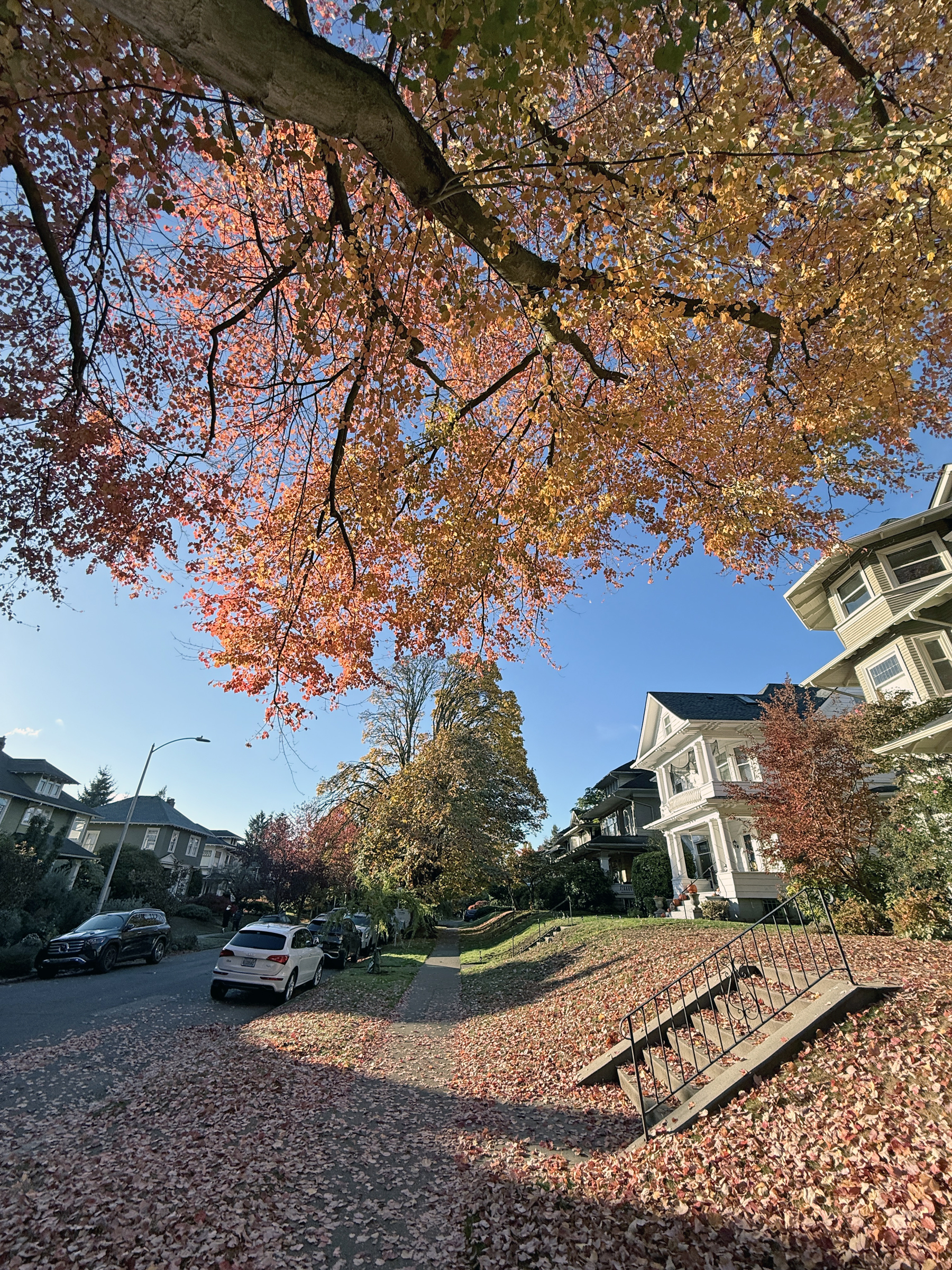
I thought the cherry blossoms here in my neighborhood appeared early this year— but I wasn’t sure.
Google AI confirmed that I was not hallucinating.
“Yes, some cherry blossoms and early spring flowers appeared early in Seattle in 2026, with sightings of blooming trees as early as mid-January, driven by a very mild, warm winter. While some early species bloomed early, the main Yoshino cherry blossoms at the University of Washington (UW) were projected to peak in late March, roughly in line with typical schedules.”
It has been a cold week here in the Emerald City with the low dipping below freezing on Friday morning, and a few snowflakes in the air this morning.
Highs were in the low to mid-forties (6° to 7°C).
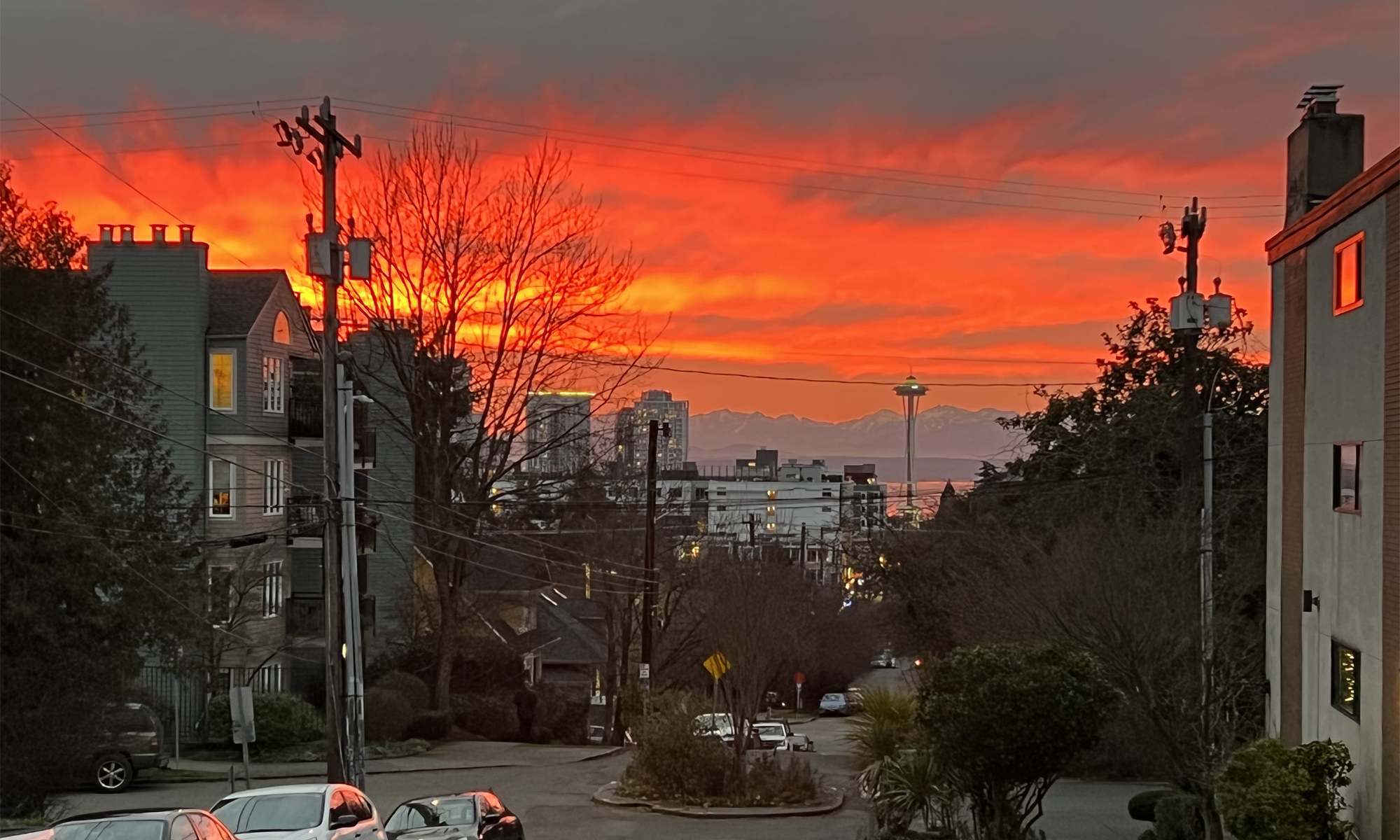
Here is a late afternoon sunbreak on the Cascade Mountains today.
I am standing at Capitol Hill’s 23rd Avenue and Mercer Street.
That is Lake Washington and downtown Bellevue in the foreground.
Happy Friday.
Breaking News: The Supreme Court of the United States (SCOTUS) ruled today in a 6-3 decision that Trump’s sweeping tariffs on imports from nearly every U.S. trading partner are unconstitutional.
Last April, in 2025, Trump had claimed that a 1970s emergency statute* (which does not mention the word “tariffs”) allowed him to unilaterally impose the duties without congressional approval.
*The International Emergency Economic Powers Act (IEEPA) of 1977.
It authorizes the President to regulate international commerce, including limiting or taxing imports, upon declaring a national emergency in response to an “unusual and extraordinary threat” from abroad.
The SCOTUS justices for the majority noted that no other US president had invoked the statute to impose any tariffs — let alone tariffs of this magnitude and scope. Tariffs are a tax and the President of the United States must identify clear congressional authorization to exercise it.
The U.S. Treasury has collected about $240 billion in tariff revenue since April 2, 2025. Consumers paid about 90% of that.
Trump is, um— shall we just say, mightily upset— over this ruling, and immediately ordered a new 10 percent tax on all imports to the USA.
For justification, he is using the 1974 Trade Act and a provision called Section 122.
(No president before him had invoked that provision, either.)
Section 122 was designed to address short-term emergencies, not long-term trade policies.
It can only be put in place for 150 days.

Ben Casselman and Ana Swanson write for the NY Times:
The total trade deficit, including trade in both goods and services, shrank slightly last year, as growth in exports narrowly outpaced growth in imports. But that was entirely the result of an expanding trade surplus in services. The trade deficit in physical goods, which has been Mr. Trump’s focus as he has sought to use tariffs to restore the U.S. manufacturing sector, actually grew in 2025.
The trade deficit grew sharply at the end of the year, rising 32.6 percent in December as imports rose and exports fell.
[Graphic by Keith Collins]

November was, for me and many others in tech, a great surprise.
Before, A.I. coding tools were often useful, but halting and clumsy.
Now, the bot can run for a full hour and make whole, designed websites and apps that may be flawed, but credible.
I spent an entire session of therapy talking about it.
The tech industry is a global culture — an identity based on craft and skill. Software development has been a solid middle-class job for a long time.
But that may be slipping away.
What might the future look like if 100 million, or a billion, people can make any software they desire?
Could this be a moment of unparalleled growth and opportunity as people gain access to tech industry power for themselves?
– Paul Ford writing in a guest essay for the New York Times
Off the top of my head I can think of a few things I would like to vibe code:
A bot that can search Ebay and the half dozen online stores for me to find postage stamps that I am looking for (Ebay’s new terms ban the use of AI bots for searches— but my bot will outsmart Ebay and elude detection);
A bot that can teach me to speak a little bit of a foreign language before I travel to that country (Duolingo and AI chat bots can just about do that already);
A PC housekeeping app that can learn how I use the directories on my computer and organize my files accordingly, especially ones I download and have to forever —aargh— retrieve from the Download folder and move elsewhere, or remember to go and delete them;
An all-in-one weather app that will tell me at the end of the day what the day’s high and low was (in both the international standard unit of measure called Celsius and Fahrenheit), what the precipitation was (if any), high wind speed & direction, UV index, atmospheric pressure, sky conditions (cloud cover) and hey, throw in phase of the moon, so that I have a heads-up for when the full moon is coming;
A sports app that will track where and exactly when Carlos Alcaraz (world No 1 tennis player) is scheduled to be playing next, and alert me.
Happy Lunar New Year— the Year of the Horse.
I bought this coin recently while I was in Singapore from the Monetary Authority of Singapore (MAS), as a souvenir.
It is not silver, but a nickel-plated proof-like zinc coin.
Majulah Singapura (on the back of the coin) is a Malay phrase meaning ‘Onward Singapore’ or ‘Forward Singapore’.
Happy Presidents’ Day.
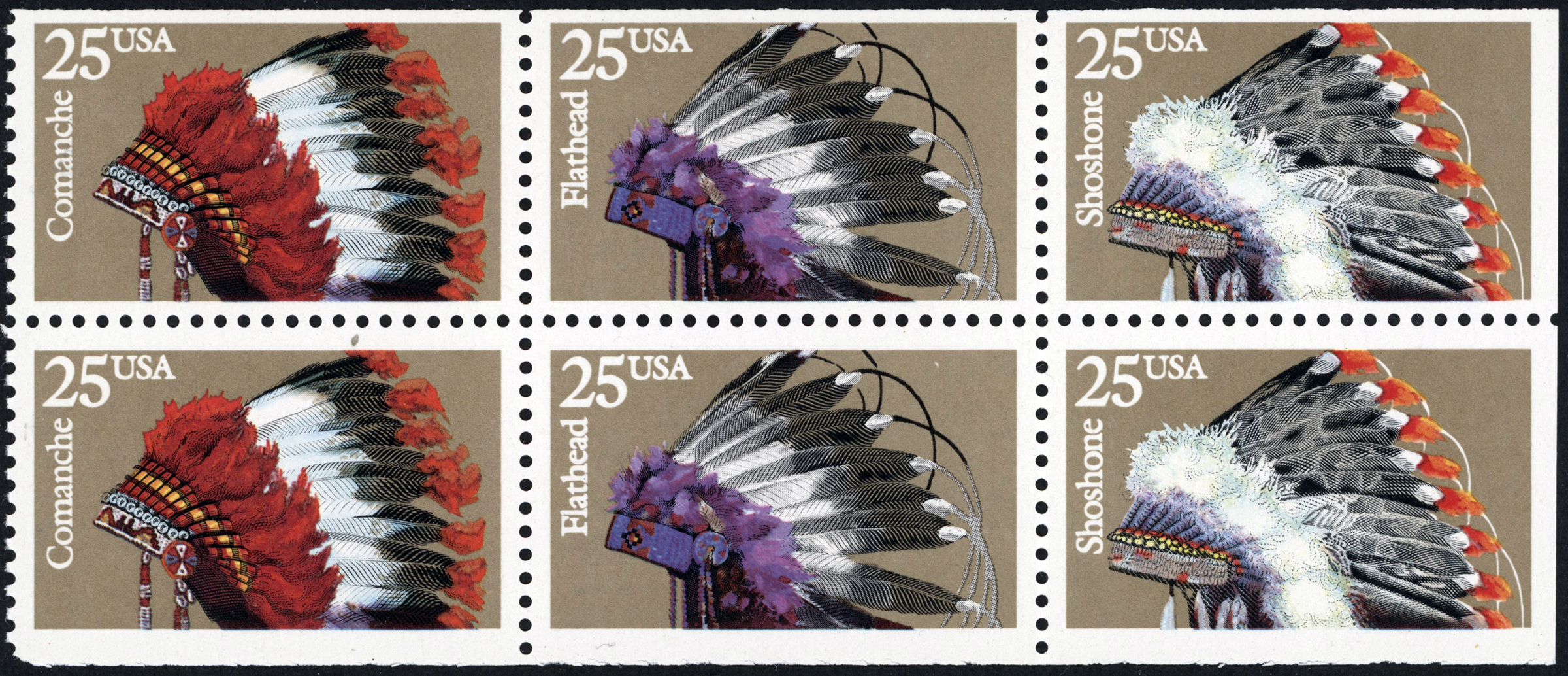
This ensemble of US presidents on postage stamps issued by the U.S. Postal Service is from my modest collection of US stamps.
President George Washington appeared on one of the very first U.S. postage stamps issued in 1847 (a 10-cent stamp). He subsequently appeared on over 300 different U.S. postage stamps— more than any other individual in U.S. postal history, and more often than all other U.S. presidents combined.

Happy Friday The Thirteenth.
The postage stamps I had bought from an Ebay seller in Mumbai, India, made it into the mailbox on my porch this morning.
Here are some of my favorite ones.


Issued by Royal Mail, Great Britain, Mar. 2, 1993 | Perf. 14 | Design B. Craddock | Lithography | Printer: House of Questa | Silver die-stamped w. Braille symbol for “10” embossed | Paper contains fluorescent colored fibers which, together with the ink on the shield, react under ultraviolet light
1658 1088| £10 Greenish grey, rosine, yellow, new blue, reddish violet, vermilion, violet, bright green and silver
[Source: Stanley Gibbons stamp catalogue Part 1, British Commonwealth 1997, Vol.1]
Britannia is the ancient Roman name for Great Britain and the national personification of the United Kingdom, often depicted as a helmeted woman with a trident and shield. Originating from the 1st century BC, it became a enduring symbol of British strength, power, and identity. It frequently appears on coins, on stamps and on artwork.
– Google AI
These imperforate labels, printed in red on phosphorized paper with grey-green background design, were first issued on 1 May 1984 as an experiment by the Post Office. Special microprocessor controlled machines were installed at post offices in Cambridge, London, Shirley, (Southampton) and Windsor to provide an after-hours sales service to the public.
The machines printed and dispensed the labels according to the coins inserted and the buttons operated by the customer.
Values were initially available in ½p steps to 16p.
In addition, the labels were sold at philatelic counters in two packs containing either 3 values (3½, 12½ or 16р) or 32 values (½p to 16p).
From 28 Aug. 1984 the machines were adjusted to provide values up to 17p.
After 31 Dec. 1984 labels ending in ½p values were withdrawn.
On 30 Apr. 1985, the machines were withdrawn from service.
P.S. I asked Google AI why these stamp labels were discontinued. The answer: Automated stamp label machines generally failed to achieve widespread success due to high operational costs, inconsistent print quality, and frequent technical failures.
[Source: Stanley Gibbons stamp catalogue Part 1, British Commonwealth 1997, Vol.1]
I was among the hundreds of thousands lining 4th Avenue in downtown Seattle today to catch a glimpse of the Seahawks victory parade.
I took the No 12 bus to Westlake Center and walked north along 4th Avenue to Belltown, checking in on the crowds at several of the cross street corners.
Look for Blitz, the Seahawks mascot, in my pictures below.
I believe that is defensive back Julian Love holding the Vince Lombardi trophy.
Sports anchor Paul Silvi is right next to him in the yellow KING5 jacket.
In another picture, a guy in stars-and-stripes pants wears a t-shirt that says WE.DID.NOT.CARE.
Those were the words of head coach Mike Macdonald following the team’s victory in the 2025 NFC Championship game, commenting on a reporter reminding him that many pundits had written the Seahawks off as an ‘afterthought’ in a division dominated by the Rams and the 49ers.
There is going to be a trophy celebration event at Lumen Field tomorrow at 10 am (tickets sold out in an hour or so on Monday).
Then, targeted for around 11 am, a parade will start along 4th Avenue in downtown Seattle.
The Seattle Times reminds readers that in 2014, hundreds of Seahawks fans had already camped out along 4th Avenue by 6.30 am .. and also that the day is sure to set light rail ridership records.
In 2014 some 500,000 people attended the parade and at that time the light rail ran only from Capitol Hill to Seattle-Tacoma airport.
BEEP BEEP THE HAWKS ARE BACK IN SEATTLE.
And so are 750,000 of your closest friends, all coming to Seattle to celebrate our SUPER BOWL CHAMPS.
So if you’re heading to Seattle tomorrow, take whatever ferry, bus, train, or spinning teacup is closest to you.
Please.
– Tweeted on X by Washington State Dept. of Traffic @wsdot